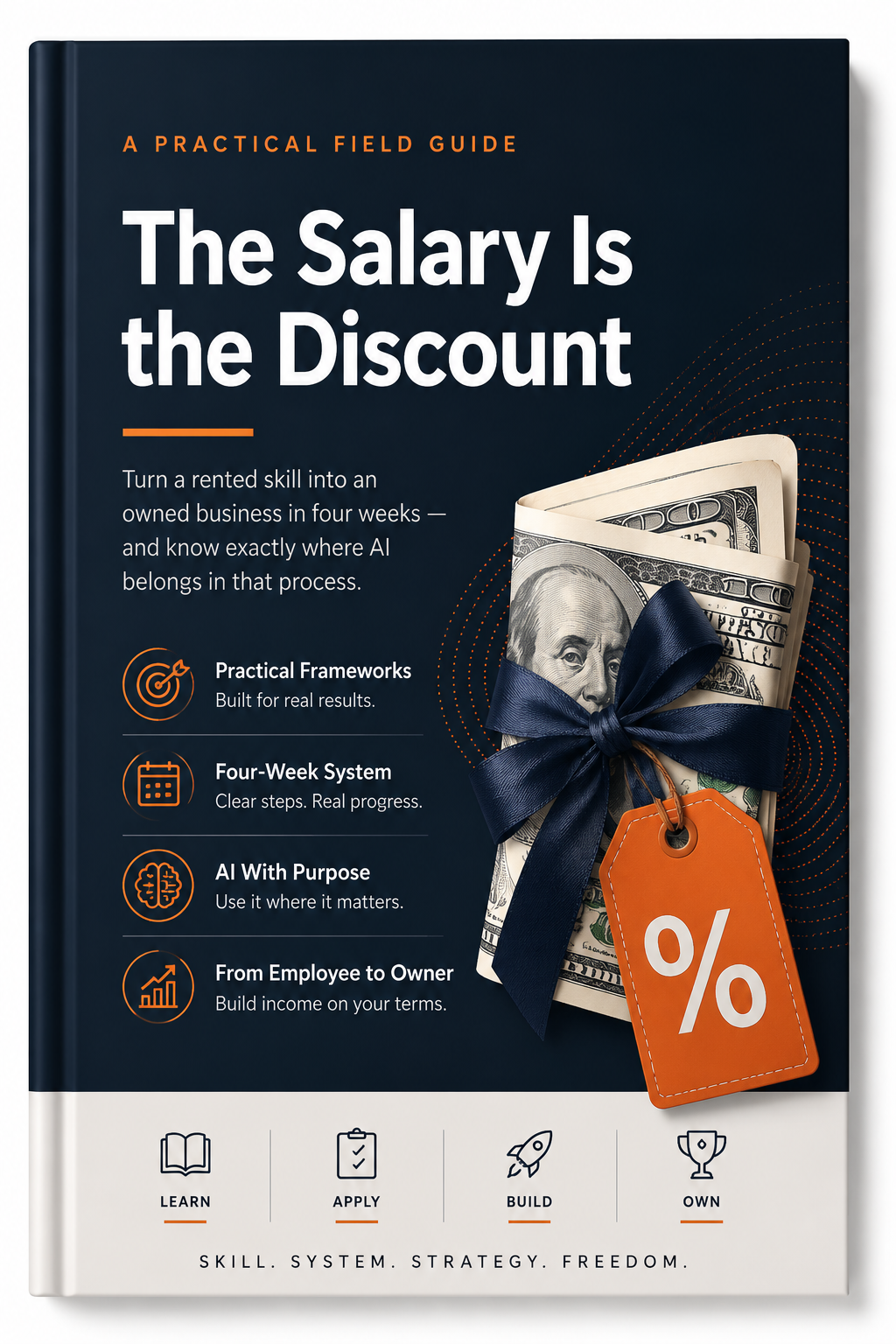
The Salary Is The Discount
Your employer pays you one number. Consultants charge a much larger one for the same work. That gap is the deal you signed — exclusivity in exchange for predictability — and this book is about what happens when you stop signing it.
- Secure checkout and instant download on Gumroad
- Re-download anytime from your Gumroad library
About this resource
There's a number on your payslip, and there's a number consultants charge for the exact work in your job description. They are not the same number, and they are not close. That gap isn't a scandal. It's the deal you signed. You traded exclusive access to a skill for a predictable deposit twice a month, and for a long time that was a reasonable trade. This book is about what happens when you stop making it. The Salary Is the Discount is a short, practical guide to selling a skill you already have to businesses that need it more than your employer does. Not a new career. Not a course to complete first. The same work, sold directly, at what the market actually pays for it. The method runs four weeks: Week one, you separate the skill from the job title. Nobody buys "Senior Program Manager." They buy "cut vendor onboarding from six weeks to three." Most people spend years trying to sell the container instead of what's inside it. Week two, you find the businesses losing money right now because nobody there can do that thing. Not everyone who could use it — the ones actively bleeding. Weeks two and three, you talk to ten or thirty of them before you build anything. This is the step almost everyone skips, and skipping it is why offers launch to complete silence. Week four, you go back to those same people with one page. Price, scope, timeline, what they get. You're not cold-pitching a stranger. You're returning to someone who already told you the problem, with the problem written down and a number attached. AI appears in this book, but later than you'd expect. It's genuinely good at pulling a sellable skill out of a résumé, researching what consultants charge, and running most of your delivery once clients exist. It cannot build trust, and trust is where the early sales come from. There's an exact prompt inside for the first job and a clear warning about the second. Also inside: how to read that prompt's output without chasing the wrong number, the three mistakes that cost people a month, the arithmetic behind a target income and which versions of it are realistic, and why mastering one tool beats collecting forty. A final note on what this book is not. The last section is called "Where the method is weakest," and it's there on purpose. The close rate this approach depends on holds among people who already trust you and drops sharply on cold outreach. The revenue tables are multiplication, not forecasts. Nothing here earns money while you sleep — it's a services business with lower delivery costs, which is a good thing to own and a poor thing to mistake for passive income. If you want a book that promises otherwise, there are hundreds of them, and they outsell this one. This is for the person who has spent years making someone else money and has started to wonder, specifically and with numbers, what that skill is worth to somebody who isn't their employer. Short enough to read in an evening. Structured so you can start on Saturday.
What's included
- Quick-start guide
Why it helps
- You find out what your skill is actually worth — with a real number — before you risk anything.
Frequently asked questions
Do I need to quit my job to use this?
No, and the book argues against it. The method works alongside employment — the conversations take twenty minutes each and the first engagement is typically four weeks of part-time work. This Guide is explicit about keeping three to six months of reserve before going full-time. Quitting first doesn't accelerate anything; it just removes your margin for error, which is what lets you turn down a bad client in month two.
I'm not technical. Is this still for me?
Yes. The skill you sell is whatever your employer already pays you for — operations, finance, HR, project delivery, client management. AI handles production work in the background; you never need to build anything. The book actively warns against positioning yourself as an AI consultant, because your industry knowledge is the asset and the tool is just a multiplier.
How is this different from every other "make money with AI" guide?
Most start with a tool stack. This one starts with a skill you already have and doesn't mention a tool until the delivery stage. It also includes a chapter called "Where the method is weakest" that explains the conditions under which it stops working — the close rate depends on warm contacts and falls on cold outreach, the revenue tables are multiplication rather than forecasts, and nothing here is passive income.
What if my network is small?
Twenty to forty names is enough to start, and most people underestimate what they have once they count former colleagues, ex-managers, and second-degree introductions. But the honest answer is that a small network runs out faster. This guide covers exactly that — referrals, narrow authority, partnerships with accountants and IT providers who already sell to your buyer, and targeted cold outreach with realistic conversion expectations.
Will this work outside the US?
The method is geography-neutral — it's conversations, an offer, and a deposit. What varies is pricing, which you research for your own market using the prompt inside, and the legal and tax side, which the book flags as something to check with a local professional rather than guessing at.

Not ready to download?
Get free guides and templates in your inbox while you decide.